First Snow
Into the high mountains of Val Fex. A journey through alpine heritage and landscape.

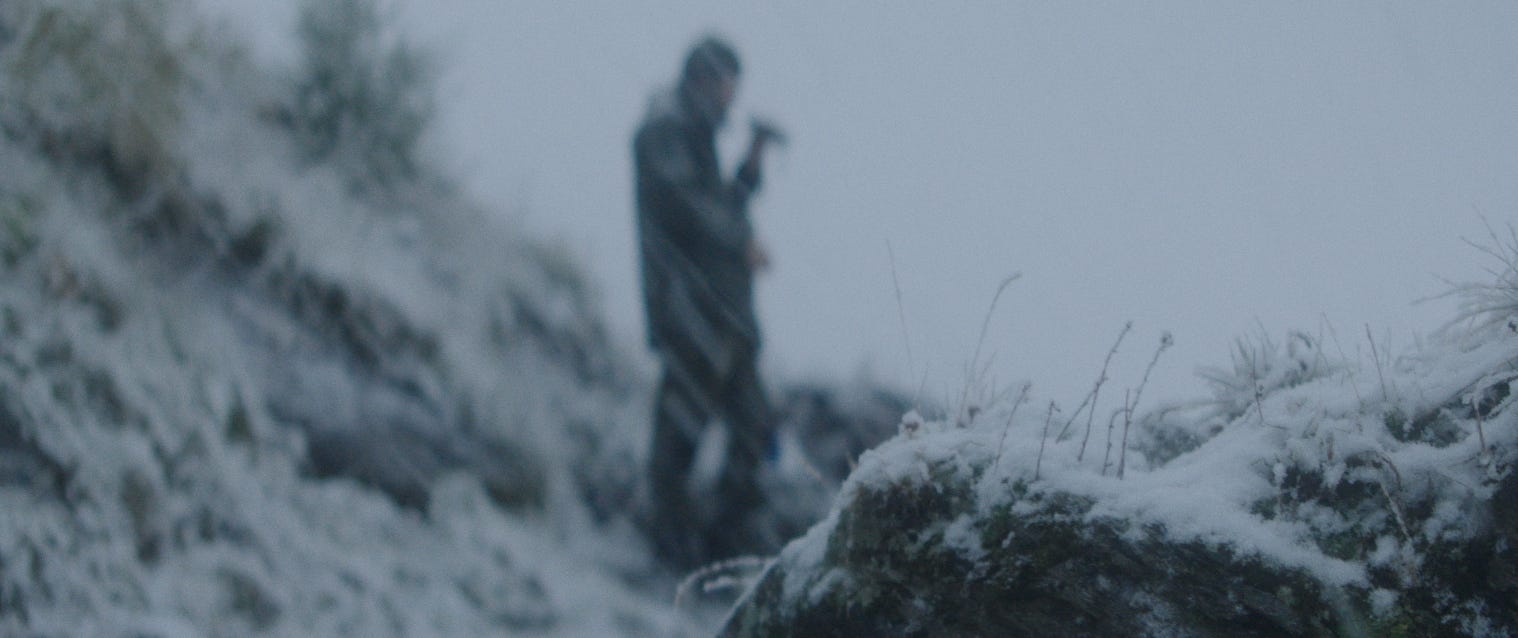
It starts with a few drops of rain, and within minutes we are engulfed in in a flurry of snow.
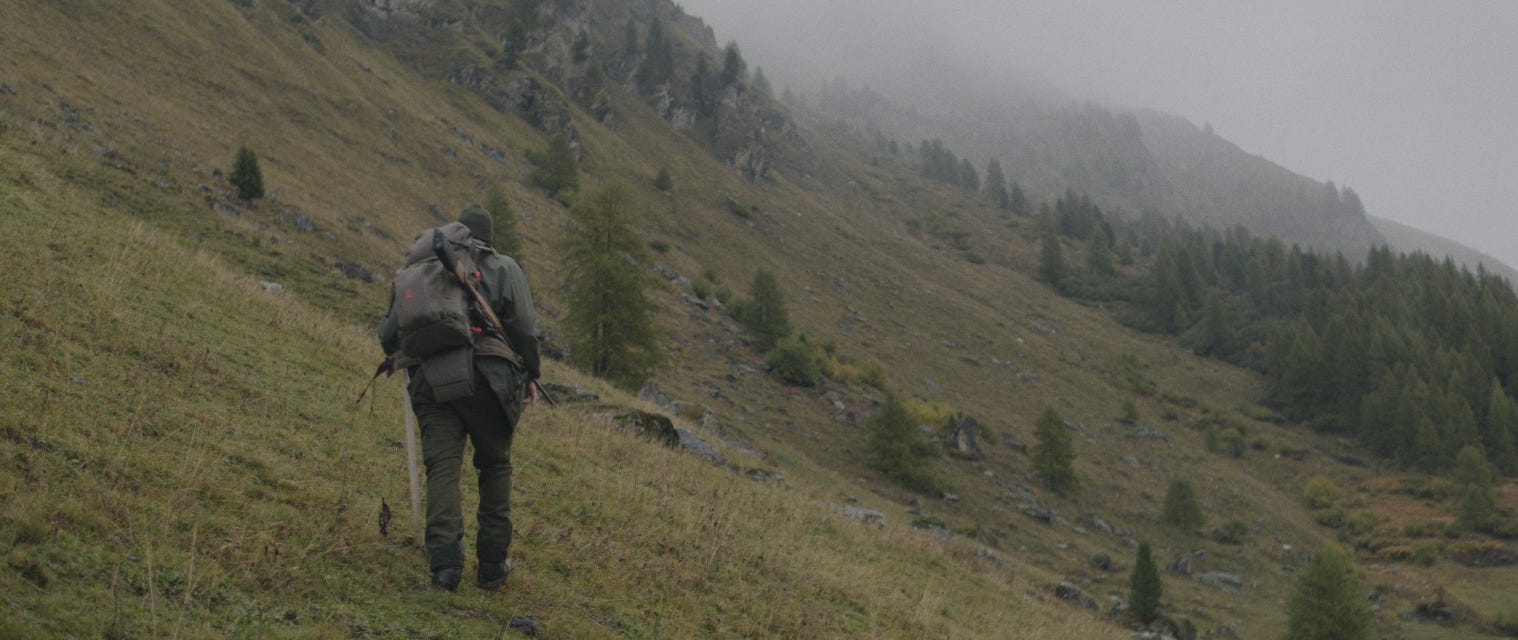
The gradient is steep and unrelenting, partly due to Roger’s preferred course up the mountain: straight up.
I grasp onto tufts of grass with one hand, carefully handling my camera rig with the other, occasionally wiping it down with a cloth in a vain attempt to stop the inevitable.
He’s not waiting, and as I pause to shoot scenes of the landscape turning from forest green to pure white, I look up to see he has disappeared almost instantaneously — much like the elusive forest creatures which he is tracking down.
Climbing upwards, I crest over the edge of the slope and notice the cliff face towering above, providing a dry enclave which Roger is hiding out in. Locals knowledge.
He rolls up a cigarette and cracks open an alcohol-free beer. We take a minute to brush off the melting snow and to get our bearings.
Visibility is low. Above us, the cliff-edge drops into the empty space of infinite white. The snowflakes are bigger than any I have ever seen. I find myself lost for words.
“It’s almost like a psychedelic experience…” I say to Roger.
He nods in silent agreement, toking on his cigarette. The smoke drifts into the breeze, merging with the cloud above our heads.
Breath, smoke and snow. Human, forest and mountain — all blurring into one. The boundaries dissolve like snowflakes on skin.
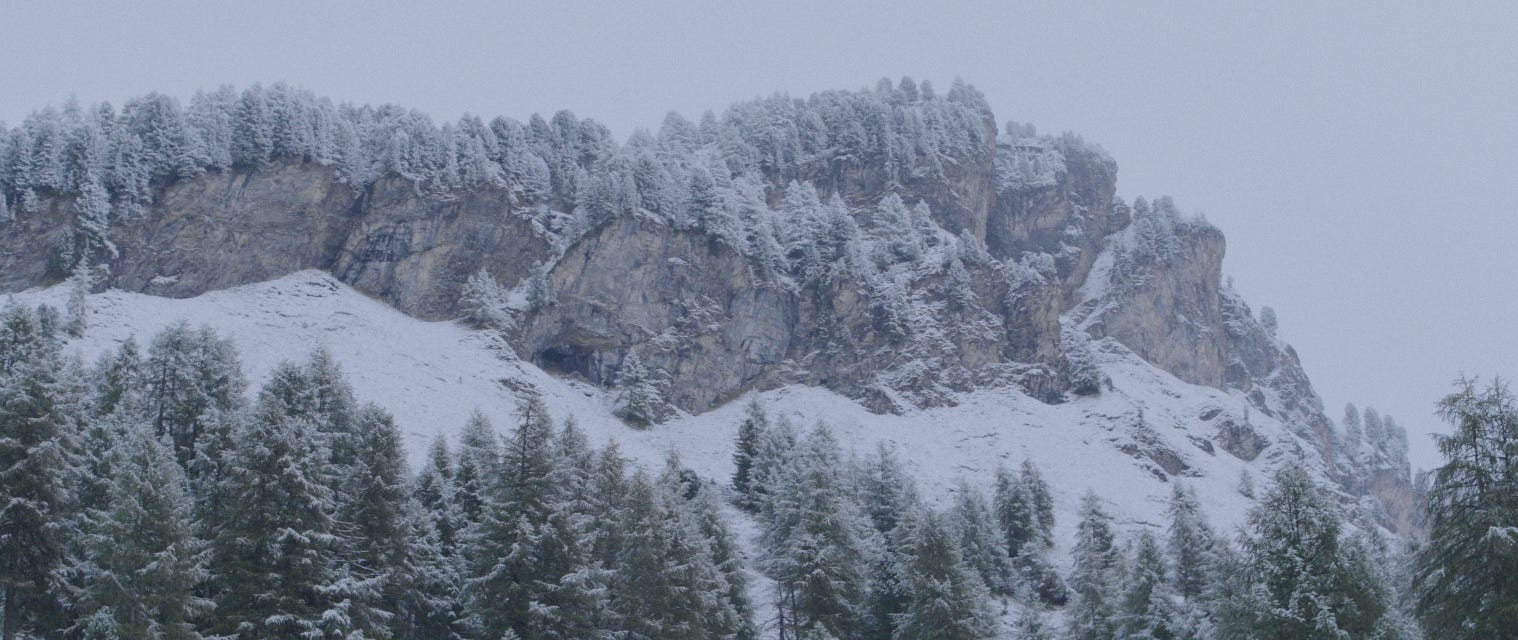
One week after the autumn equinox, the seasons have shifted dramatically: in a matter of days, the sun and warmth have given way to a complete whiteout.
Welcome to the Alps.
A month had passed since I first met Roger and filmed his creative process of knife-making in the workshop beneath his farmhouse. I was so inspired by our meeting that I hastily assembled a treatment for a longer documentary, imagining the project’s potential.
In that time, reality hit once again.
A scramble to switch from the artistic to the commercial brain, to dig out of the survival hole that has become all-too-familiar. Thankfully some progress was made, if such a word is even the right one to use — and then I received a text.
“Hallo Adrian. Wie siehts am Dienstag am späteren Nachmittag aus? Hättest du Zeit um mit zu kommen? 🦌”
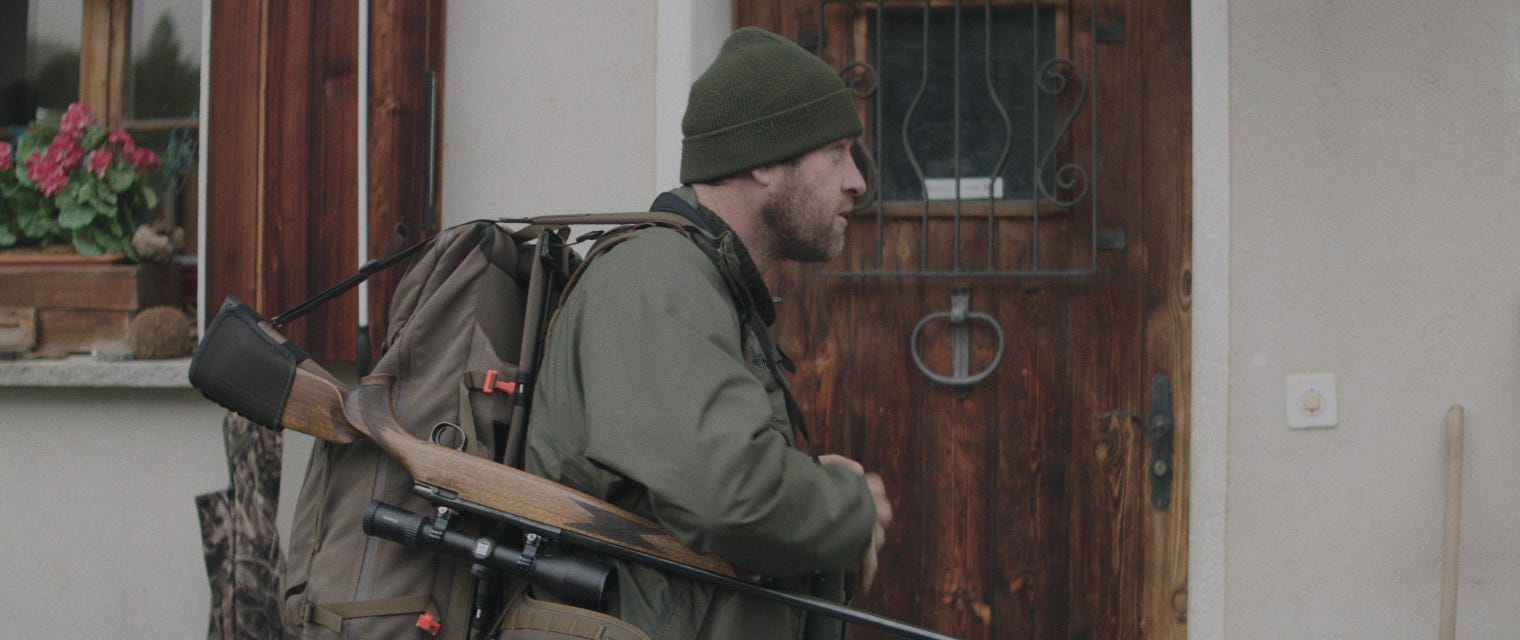
It was an invite from Roger to join him on a late-afternoon hunting hike into the mountains above Val Fex — an offer I couldn’t refuse.
At this point, I feel it is important to add a disclaimer of sorts.
As a previously militant vegan in my teenage years, the idea of joining someone on a hunting trip is something I never would have imagined. Despite rejecting the label nowadays, my ethics have largely remained the same.
I still don’t eat animal products and I’m absolutely opposed to trophy hunting, but this is a different context entirely.
In the quest to capture the life experience of a Romansh farmer and artisan, it is important to portray things as they are.
Hunting is an integral part of the culture in these alpine valleys, and although some trophy-element does exist, Roger’s relationship is completely different. The animal that he hunts will feed his entire family through the winter, nothing will go to waste.
In a way, this is a practice that very close to the indigenous culture of the high Alps: where soil is poor and the growing season is short, there is a greater dependency on wild-sourced food.
In older times, hunting the many deer, ibex and chamois that roam these glacial valleys was not only practical choice, but essential for survival.
In the present day, of course it is possible to visit the nearest large town and buy what you need from a supermarket — but given the inherently exploitative nature of industry, coupled with intensive chemical farming, I have a lot more respect for these locals who venture into the hinterlands, maintaining a degree of self sufficiency and autonomy in a world which becomes increasingly homogenised and controlled.
In a way, to source one’s own food nowadays is an act of resistance.
“What the hell is he doing here?” Roger jokes, pointing to his father in the distance, occupying the hunting cabin.
Smoke pours from the chimney. The smell drifts on the breeze. He whistles. His father whistles back. A code-whistle, perhaps.
Marco, Roger’s father, looks exactly how I would imagine him to. A weather-worn mountain man, a face like old leather — wearing a beaming smile. A paradoxical character: as hard as granite and soft as the autumn sun.
We shake hands and greet, and they proceed to exchange words in Romansh that I cannot understand. To the unfamiliar ear, it sounds a little like Italian mixed with Swiss German. It has an unmistakable lyricism that is pleasing to listen to.
As Switzerland’s minority language, it is only spoken by tens of thousands and has been in gradual decline for hundreds of years. Efforts have been made to preserve it, but given the complexity of having four different dialects — combined with the pressures of globalisation and the dominance of German as an administrative language — it has been fading into obscurity.
Roger explains to me that his father lives in Val Bregaglia now, a small, Italian speaking valley on the border. Not out of choice, but out of necessity. It was too expensive to stay in his home valley.
“Does your father miss Val Fex?” I ask.
“Yes, his heart is here. The first few years were hard, but now it’s better. And he can come here to hunt, to stay in the cabin.” Roger explains.
“So it’s like his holiday home then?” I say, jokingly.
“Ha! Yes, with the other billionaires.” He responds, always able to grasp the nuances of ironic humour.
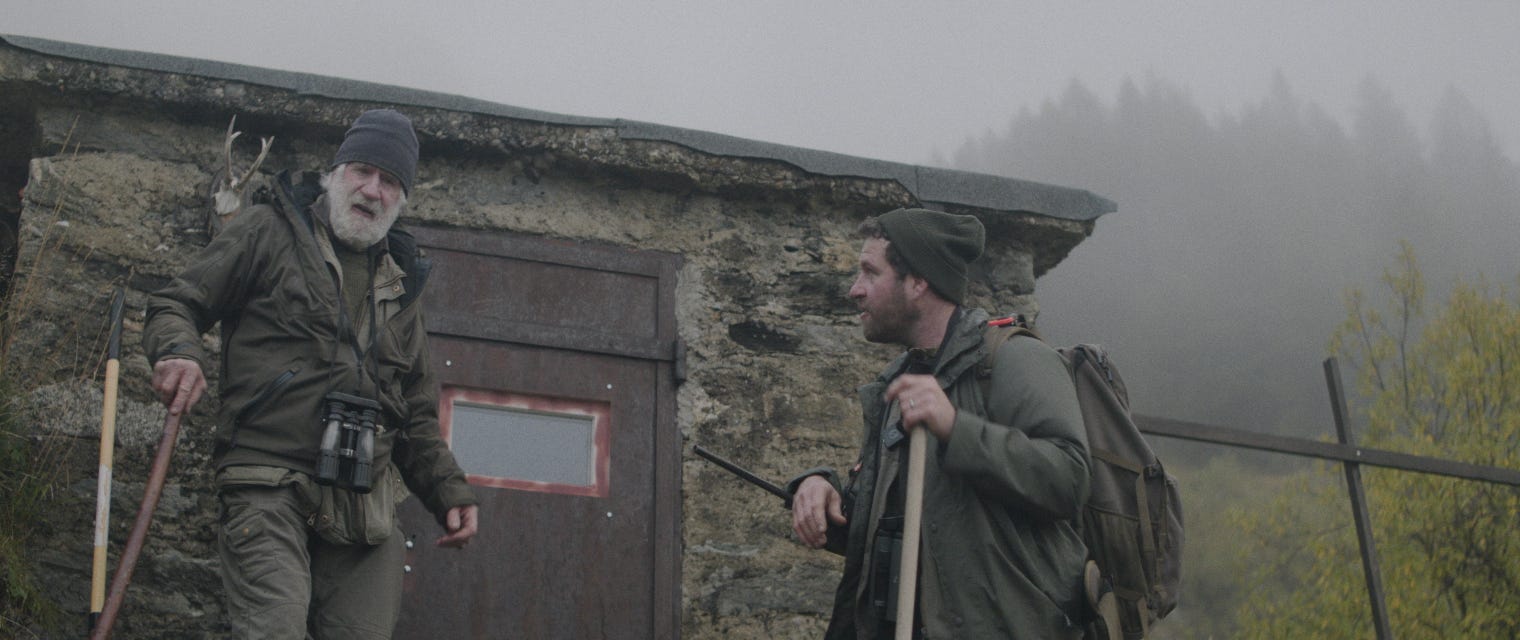
“It’s not a good day for it…” Roger mutters, withdrawing the bullet from the rifle.
The visibility is getting lower and the snow cover is getting higher.
We both have a thick layer of snow on our shoulders, but strangely it doesn’t feel that cold.
I continue to wipe down my camera, walking the razors edge between “getting the shot” and rolling the dice with camera gear which my livelihood depends on.
At just over 2000 metres altitude, it feels like being in a completely unfamiliar world.
I feel a sense of wonder-infused alienation from this landscape, which feels so different from those in which I have previously explored. We are slowly becoming familiar now and Roger is the guide in this new terrain, a bridge into the Romansh culture which is so integrally linked with the alpine.
We begin the walk back to the farmhouse, pausing occasionally. I follow his track over the uneven ground. Silhouetted footprints cast against infinite white.
“Sometimes the deer come down here from the forest, and across this way…” He traces the route with his finger.
The trail is turning into a slushy mix of snow and mud. Silence is everywhere and nowhere. It falls from the sky, echoing through the larches. It is both sound and soundless. Form and formless.
We pause beneath a spruce tree. One final wait to see if an opportunity reveals itself.
He pulls out the binoculars once again, scanning the distance with precision. A dry circle surrounds the trunk of the tree, a patch of needle-brown contrasted against the carpet of white that extends into the horizon.
It seems that today will not be the day.
I’m realising that in the world of alpine hunting as Roger knows it, the process is just as valuable as the outcome — and more than that, this practice connects him to a centuries-old relationship with the wilderness, an integral element of the Romansh culture that still remains — even as the world around him changes.
We brush past the snow-covered spruce needles. Ice falls down my back, melting into cold water. The stream sings through the meadow, the only sound in a seemingly soundless place. Boots crunch over glazed grass.
I pause for a moment to capture the scene.
Before I know it, Roger disappears into the distance once again. A lone silhouette in a whiteout landscape, fading into the black of night.