Glatsch
Witnessing the threshold between worlds on Lej da Segl.

“These mountains and lakes have more to say to me than can be fully absorbed and appropriated at first sight…”
- Hermann Hesse, writing of the Engadine
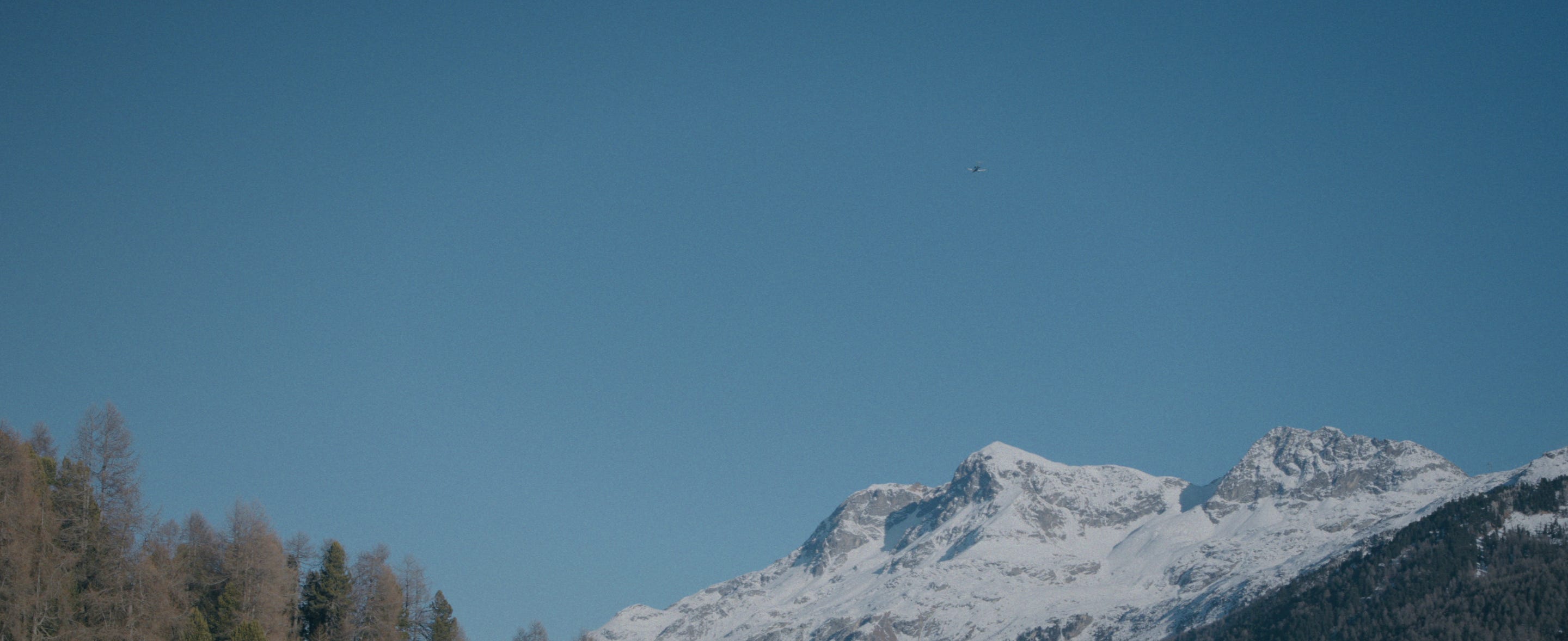
This is the last opportunity now before the snow comes again. And it’s the coldest day of winter so far. The temperature reads -19 degrees centigrade. A private jet flies overhead and the sound reverberates through the valley, rumbling from glacier to peak.
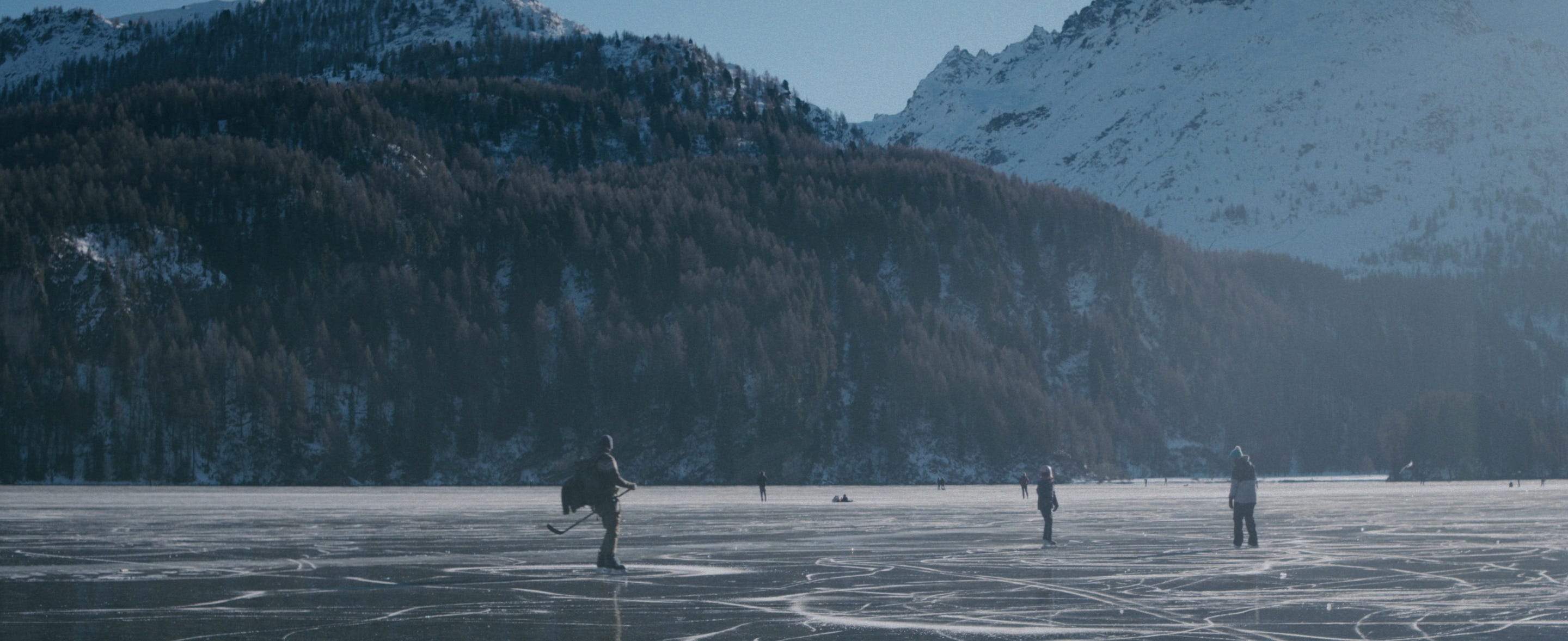
I am standing on a threshold, a translucent barrier marked with fractal patterns of bubbles and cracks, separating human body from water body.
Reflections of the surrounding peaks are mirrored along this textured surface. Fractures are formed like ridge lines. Trapped bubbles remain caught between states. The microscopic and the macroscopic dance with each other.
Human figures fly across this temporal landscape with speed and fluidity, etching marks into the ice that will soon be obscured with infinite white.
Below the surface, time itself feels frozen, and the weeds hang in suspense. Strange, supernatural sounds are emanating from below, akin to the singing of whales. Pulsing tones that echo across the valley, reverberating between ice and rock.
“What is this?” I ask with curiosity.
“It’s voodoo!” Roger exclaims, and I don’t know whether he’s joking or not.
Lej da Segl is frozen solid. Glatsch. A temporary yet impermeable layer between the two aspects of the alpine world: the terrestrial and the aquatic.
Today, I have been invited to join Roger and his family to experience the Engiadina winter the local way, before the weather shifts again. He tells me that the winter’s used to be different here, but you never know anymore.
We park in the village and walk along the valley floor. I’m playing the balancing act of holding conversation and filming — adjusting many manual settings while walking, constantly adapting to the changing light and pace.
“This whole area used to be a meadow before they built houses on it…” Roger shares.
I look around at these refined, modern houses — a distant echo of the classic form of the Engiadina farmhouses you find dotted across the valley. They are still pleasing to look at, but somehow lack the raw character of the historic farmhouses.
Sils Maria / Segl is a town famed for being the temporary home and geographical muse to Friedrich Nietzsche, among other artists who were similarly inspired by the light-soaked landscapes of the Engiadina.
Due to its proximity to St. Moritz, it has become an area known for hotels and high-value real estate. Yet there is something different about this place.
Indeed, the ancestral residents are extraordinarily wealthy compared to many mountain folk, yet those I’ve met carry a sense of humility and connection to the landscape that is equally exceptional. They haven’t yet lost their roots.
“You see the caves up here on the mountain?” Roger points towards the Albula Alps.
“I used to go up here with a friend to hang out and make campfires. These caves are full of shit, fifty centimetres deep from the chamois and ibex!”
We continue walking along the trail, surrounded by Nordic skiers, dog walkers and seasonal tourists. The intense winter sunlight seems to counterbalance the cold — two elements in their extreme, creating a sort of harmony between them.
The vista of the lake leaves me speechless.
Even with spikes on my shoes, I feel unsteady. I look below the surface and feel vulnerable, like peering through a glass floor on a skyscraper. It’s a sort of ice-induced aquatic vertigo.
Roger, his wife Martina, and his daughter Marina interact with this ice world with nonchalance, lacing up their ice skating shoes and effortlessly gliding along the surface. An environmental fluency to the alpine that belongs to those who know its ways.
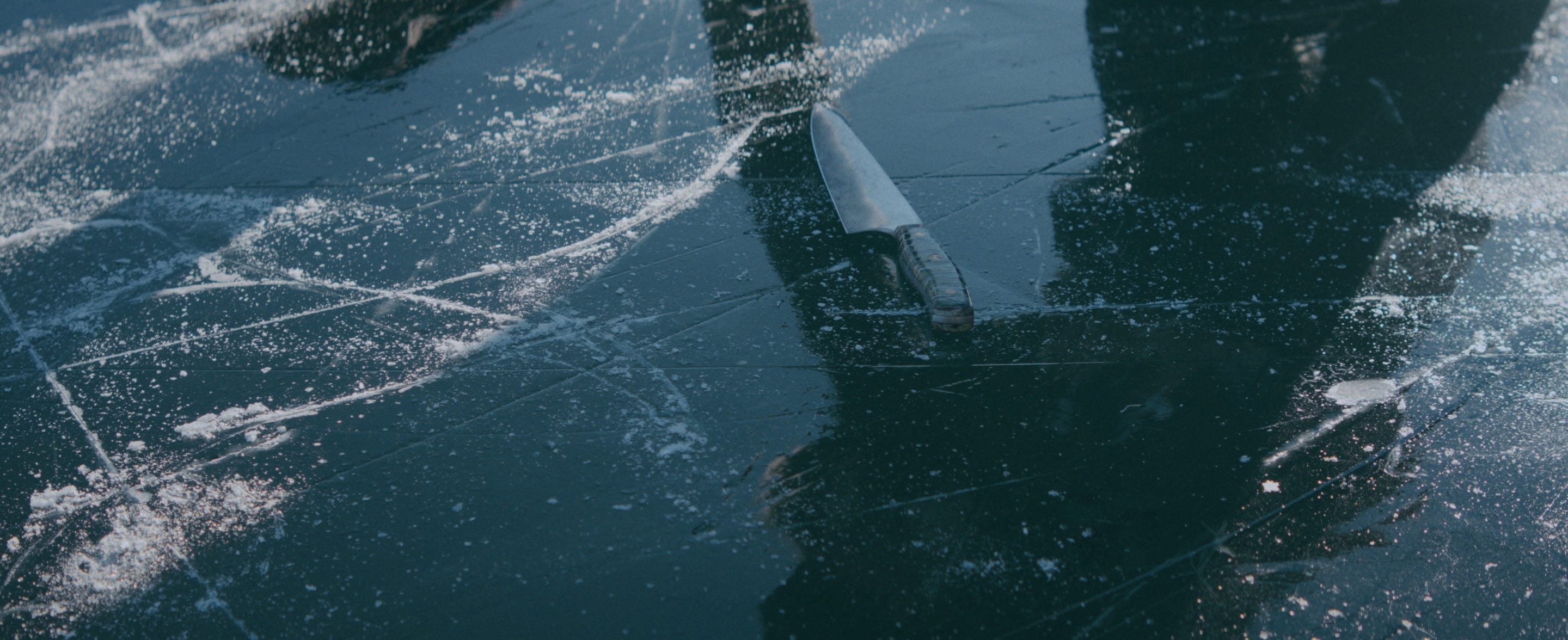
Martina is searching for the perfect surface to take photos of Roger’s most recent knife, inspired by the glacial colours and textures of winter. I follow her movements, acutely aware of this interplay between art forms and material — light, fire, metal, and glass.
“Sometimes I don't even want to sell them…" he once said. Nowadays it’s easier, since it became more of a business.
Feeling a rush of air, I turn and see Roger flying past me, hockey stick in hand, spinning and weaving across the frozen surface.
The bubble of wonder is burst for a moment when their daughter Marina trips on the cracked surface and lands hard on the ice. Despite some tears, no harm was done, thankfully.
The afternoon light hangs low in the sky. Everything is golden, illuminated. I shake my hands with intensity, trying to shift the blood downwards and regain sensation once again in my icicle fingertips. This paradox and juxtaposition between beauty and pain never ceases to amaze me.
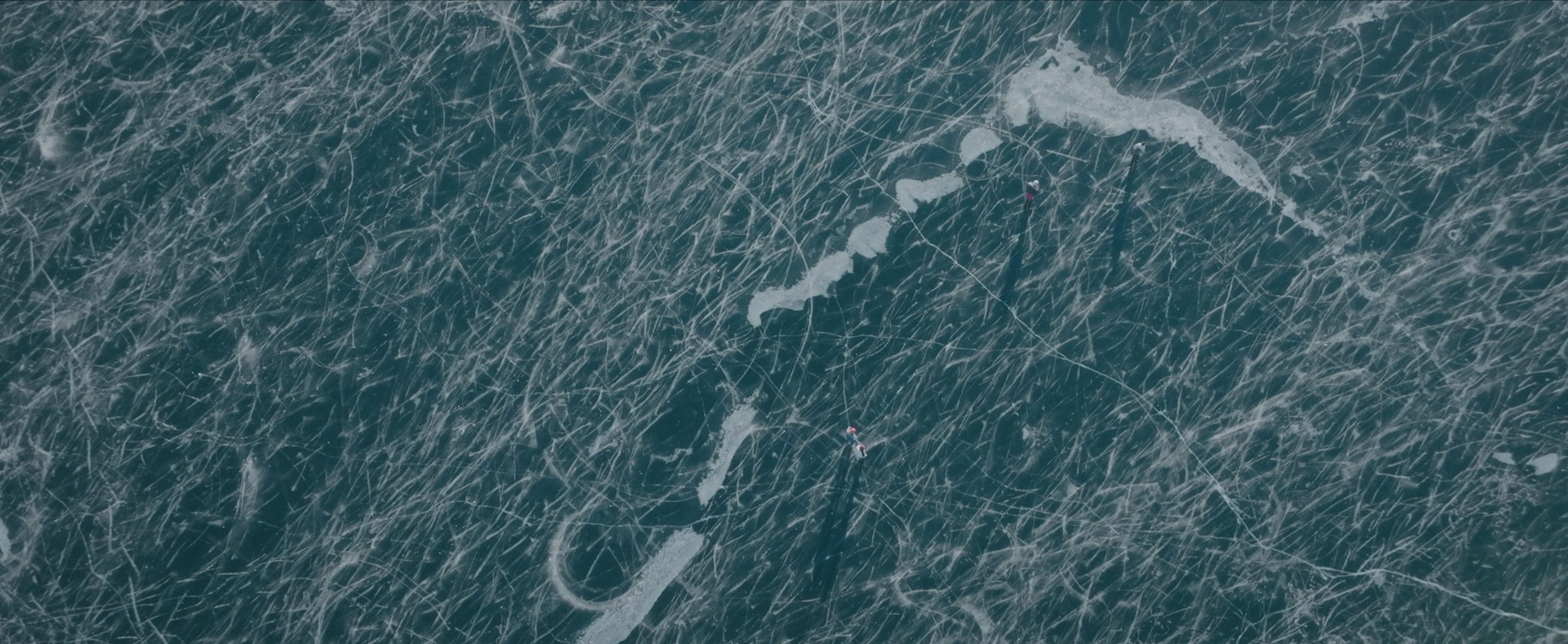
With the drone up in the sky, the perspective once again shifts to awe and wonder.
Tiny human forms glide and swirl over this ice-sculpted otherland. Shadows are cast deep against the angle of light, interspersed between fractals of cracks and grooves carved by skates.
I try to make out which one is Roger from this tiny LCD screen, but he is easily spotted amongst this small ocean of human figures: weaving with ease and uncanny speed, bordering on danger — a man deeply connected to the elements of this world of ice, light, and rock. He thinks little of it.
What fascinates me about these valleys is the fact that the ancestral residents — despite fully integrating and adapting to the modern world (and often to great advantage) — still have such a strong connection to these mountains.
Perhaps it is language that is the thread of continuity between past and present: when your way of communication is so inherently rooted in place, it creates an enduring sense of relationship that becomes lost with the global languages.
The irony, of course, is that Romansh is itself a colonial language. This amalgamation of Rhaetian and vulgar Latin, evolving over thousands of years into five distinct dialects, was born from the conquest of the Roman Empire.
But what happens in the remote areas of the alpine terrain, such as the Engadine, where industrialisation, homogeneity, and globalisation took far longer to reach?
The inherent connection to place remains stronger.
Specific words that describe the landscape — valleys, glacial lakes, streams, brooks and rivers, bogs and marshland, meadows and forests, rocky outcrops and different textures of snow, and the tone and pronunciation itself sculpted by the shape of the terrain and by the widths of valleys — this is what remains when a population is less exposed to the conditioning of the modern world.
The metropolitan or administrative perspective might argue that this lacks efficiency: how will these people develop careers, boost GDP, and climb the property ladder if they are talking in a language that most cannot understand?
Perhaps, this is the point. That locality and community cultivate a quality that is lost when everything becomes the same. And these lands are changing.
Modern architecture is creeping in with its soulless grey, concrete, and box-shaped houses, encroaching on these characterful Engiadina farmhouses.
Straight edges and industrial forms of the current paradigm are contrasted against historic buildings detailed with sgraffito, intricately carved wooden façades and doorways, and curvaceous and flowing plastered walls.
Property developers are drawn in by the “exclusivity” of this region, where sun-soaked peaks and golden larch forests become just another selling point.
Luxury enterprises increasingly search for the perfect backdrop, at the expense of local communities, biodiversity, and pristine landscapes. What is left are semi-ghost towns for tourism and holiday homes, barely inhabited and visibly lacking in life.
If you ask the locals, they are more contented to no longer live like subsistence farmers — but the questions remains: at what cost?
Despite all of this, something enduring persists — a connection to the land that hasn’t yet been severed. Held together by the delicate fabric of language, seasonal rituals connecting self to landscape, and a community that stands on the precipice between locality and globalisation.
A threshold where identity, connection and belonging begins to disintegrate, yet for now in these Grischun valleys, still remains.